
The Complete Crypto Network Guide for Beginners
Last Updated: December 2025 | 12 min read
So you’re trying to send some USDT to a friend, and suddenly your wallet asks you to pick a network. ERC-20? TRC-20? BEP-20? What do these even mean, and why does it matter?
I’ve been there. The first time I faced this choice, I spent 20 minutes googling before making a decision. And honestly? I still picked wrong and paid way more in fees than I needed to.
Here’s the thing nobody tells you upfront: the network you choose can mean the difference between paying $0.10 or $15 for the exact same transaction. Worse, if you send to the wrong network type, your funds could be gone forever.
This guide breaks down everything you need to know about these three networks in plain English. No blockchain PhD required.
What Are These Network Standards Anyway?
Think of ERC-20, TRC-20, and BEP-20 as different highways for moving the same car. Your USDT (or other token) is the car. The network is the road it travels on. Each road has different speed limits, toll fees, and destinations it can reach.
The “20” in each name refers to a technical standard – basically a rulebook that tells developers how tokens should behave on that particular blockchain. But you don’t need to care about that. What you do need to know is how each one affects your wallet.
ERC-20: The Original (Ethereum)
ERC-20 runs on Ethereum, the second-largest blockchain after Bitcoin. It’s the grandfather of token standards – most other standards were literally copied from it.
The good: Maximum compatibility. Almost every wallet, exchange, and DeFi app supports ERC-20. If you’re doing anything in decentralized finance – lending, staking, yield farming – ERC-20 is usually your only option.
The bad: Expensive. Really expensive. During busy periods, a simple USDT transfer can cost $10-30. I’ve seen it hit $50+ during NFT crazes. The network also gets congested, meaning transactions can take 10+ minutes when traffic is heavy.
Address format: Starts with “0x” followed by 40 characters (like 0x742d35Cc6634C0532925a3b844Bc…)
TRC-20: The Fast Alternative (TRON)
TRC-20 operates on the TRON blockchain, created by Justin Sun in 2017. It was designed specifically to be faster and cheaper than Ethereum.
The good: Fast transactions (usually under a minute) and historically low fees. TRON can handle about 2,000 transactions per second compared to Ethereum’s 15-30. It’s particularly popular for USDT transfers in Asia.
The catch: Fees have increased lately. As of late 2025, sending to a new wallet (one that hasn’t received TRC-20 tokens before) costs around $1-5 in TRX. Still cheaper than Ethereum, but not the “basically free” it used to be.
Address format: Starts with “T” followed by 33 characters (like T9yD14Nj9j7xAB4dbGeiX9h8unk…)
BEP-20: The Budget Champion (BNB Smart Chain)
BEP-20 runs on BNB Smart Chain (formerly Binance Smart Chain), created by the Binance exchange. It’s essentially Ethereum’s architecture but optimized for speed and low cost.
The good: Consistently the cheapest option. Transfers typically cost $0.05-0.50. Speed is excellent – transactions confirm in about 3 seconds. If you use Binance exchange, moving funds to BEP-20 wallets is seamless.
The trade-off: Less decentralized than Ethereum (Binance has significant control over the network). Also, BEP-20 addresses look identical to ERC-20 addresses – both start with “0x” – which leads to the most common mistake people make.
Address format: Starts with “0x” – exactly the same as ERC-20. This is important! More on this below.
Quick Comparison: All Three Networks
Here’s everything you need to know at a glance:
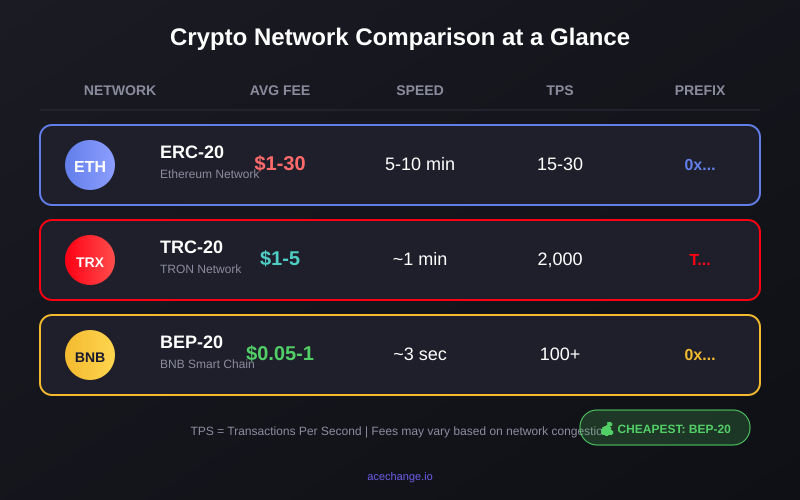
And here’s the detailed breakdown:
| Feature | ERC-20 | TRC-20 | BEP-20 |
| Blockchain | Ethereum | TRON | BNB Chain |
| Avg. Fee | $1-30 | $1-5 | $0.05-1 |
| Speed | 5-10 min | ~1 min | ~3 sec |
| TPS | 15-30 | 2,000 | 100+ |
| Address | 0x… | T… | 0x… |
| DeFi | Excellent | Limited | Good |
| Exchange Support | Universal | High | High |
Note: Fees fluctuate based on network congestion. These are typical ranges as of December 2025.
How to Choose: A Simple Decision Framework
Stop overthinking it. Most of the time, the choice is straightforward. Here’s my mental flowchart:
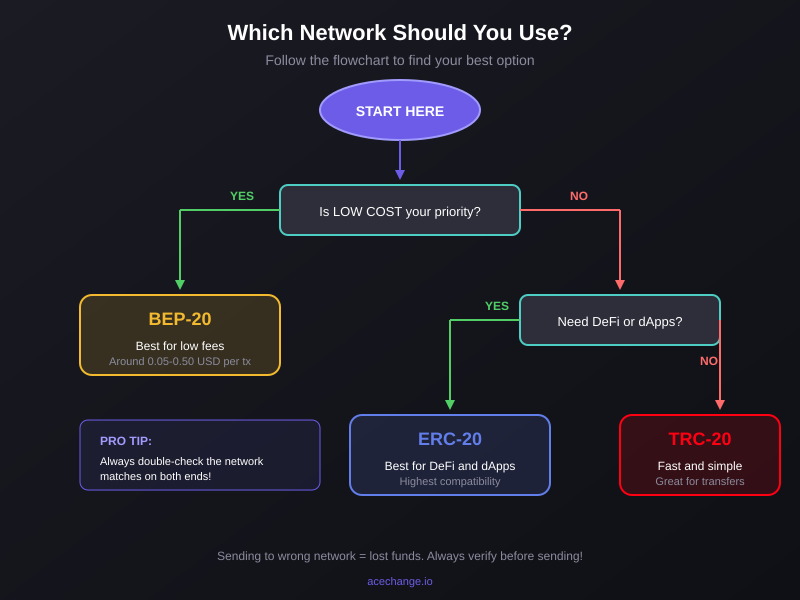
The Practical Rules
Sending to an exchange? Check which networks they support first. Most major exchanges accept all three for USDT, but some smaller ones only support ERC-20. Binance obviously prefers BEP-20.
Peer-to-peer transfer to a friend? Use BEP-20 for lowest fees. Just make sure they know to set their wallet to BNB Smart Chain when receiving.
Using DeFi protocols? Probably ERC-20. Most serious DeFi action happens on Ethereum. Yes, the fees hurt, but that’s where the liquidity is.
Just want it fast and cheap? TRC-20 or BEP-20 are both solid choices. I slightly prefer BEP-20 for consistency, but TRC-20 works great too.
The Billion-Dollar Mistake: Wrong Network Transfers
This is where people lose money. And I mean really lose money. Every month, millions of dollars in crypto vanish because someone sent tokens to the wrong network.
The ERC-20/BEP-20 Trap
Remember how I mentioned that ERC-20 and BEP-20 addresses look identical? They both start with “0x” and are the same length. This creates a dangerous situation.
Say you want to send BEP-20 USDT to your friend. They give you their address: 0x742d35Cc6634C0532925a3b844Bc9e7595f… You copy it, paste it, and send. But wait – was that their Ethereum address or their BNB Smart Chain address? If you guessed wrong, your USDT might be stuck or lost.
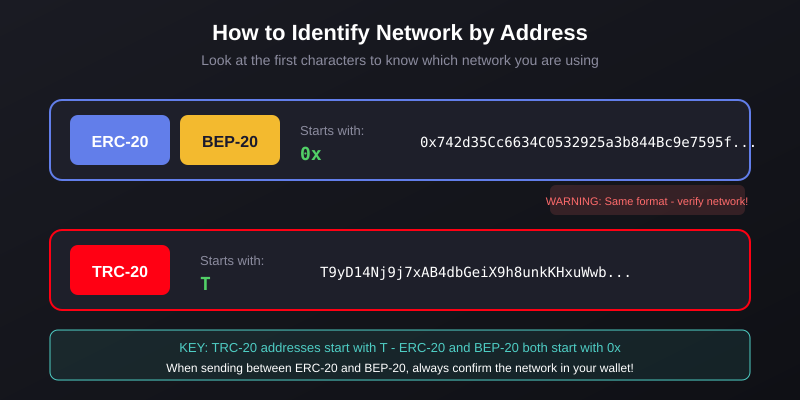
How to Protect Yourself
- Always confirm the network explicitly. Don’t assume. Ask: “Is this your ERC-20 or BEP-20 address?” Every time.
- Send a test transaction first. For any significant amount, send $5-10 first. Yes, you’ll pay fees twice. It’s worth it.
- Double-check the network selection in your wallet. Most wallets have a network dropdown. Make sure it matches what you intend to send.
- TRC-20 is harder to mess up. Those addresses start with “T” – instantly recognizable. When in doubt, TRC-20 is the safer choice for beginners.
Real-World Scenarios: What I’d Actually Do
Theory is nice. Here’s what this looks like in practice:
Scenario 1: Sending $50 to my brother for dinner
My choice: BEP-20. Fee will be about $0.10. I’ll text him “sending BNB Smart Chain” so he knows to check that network in his Trust Wallet. Done in 3 seconds.
Scenario 2: Moving $5,000 to Coinbase
My choice: Check Coinbase deposit options first. They support ERC-20, TRC-20, and others. I’d pick TRC-20 – about $2-3 in fees, arrives in under 5 minutes. Not the absolute cheapest, but Coinbase’s TRC-20 support is rock solid.
Scenario 3: Participating in a new DeFi launch
My choice: ERC-20, no question. Most DeFi protocols only exist on Ethereum. I’ll pay the $8 fee and grumble about it, but at least I know the smart contract interactions will work properly.
Scenario 4: Receiving payment from overseas client
My choice: I give them options. “Here’s my TRC-20 address (starts with T) or BEP-20 address (starts with 0x, make sure you select BNB Smart Chain).” I never assume they know what they’re doing. Clear instructions save everyone headaches.
Mistakes That Cost People Money
I’ve made some of these myself. Learn from my pain:
- Forgetting you need native tokens for fees. Want to send ERC-20 USDT? You need ETH in your wallet for gas. BEP-20? You need BNB. TRC-20? You need TRX. Empty wallet = stuck funds.
- Checking fees on a calm day, sending during a storm. Ethereum fees can 10x within hours if something big happens (NFT drop, market crash). Always check current gas prices before confirming.
- Sending to a contract address. Some tokens have addresses that look like wallet addresses. If you send USDT to a USDT contract address, it’s gone. Only send to addresses you’ve verified.
- Trusting “free” transfers on centralized platforms. Some exchanges say transfers are free, then hit you with withdrawal fees. Or they batch transactions and take hours. Read the fine print.
- Not saving transaction hashes. Every transaction has a unique ID (hash). Save it. If something goes wrong, you’ll need it for support tickets.
Frequently Asked Questions
Can I convert ERC-20 USDT to TRC-20 USDT?
Yes. You can use a crypto exchange or instant swap service to convert between networks. Most exchanges handle this automatically – you deposit ERC-20 and withdraw TRC-20. Just watch the fees on both ends.
What happens if I send to the wrong network?
It depends. Sometimes funds are recoverable (if both networks use compatible address formats, like ERC-20 and BEP-20). Sometimes they’re lost forever (like sending ERC-20 to a TRC-20 address). Some exchanges can help recover misrouted deposits – for a fee. Prevention is way better than cure here.
Why don’t all platforms support all networks?
Each network requires separate infrastructure – different node software, different APIs, different security audits. Smaller platforms focus on major networks to keep things manageable. Larger platforms gradually add more over time.
Is one network more secure than others?
Ethereum (ERC-20) is generally considered most decentralized and battle-tested. BNB Smart Chain is more centralized but still secure. TRON falls somewhere in between. For everyday transfers, all three are safe enough. For holding large amounts long-term, purists prefer Ethereum.
Which network is best for large transactions?
Ironically, ERC-20 – despite the high fees. When you’re moving $100,000, that $15 fee is nothing, and Ethereum’s robust security and wide acceptance matter more. For large sums, reliability beats penny-pinching.
Do fees change throughout the day?
Ethereum fees fluctuate dramatically – they’re lowest during Asian evening hours (when US and Europe are sleeping). TRC-20 and BEP-20 are more stable. If you’re sending ERC-20, checking current gas prices on etherscan.io can save real money.
Can I use any wallet for any network?
Not quite. Most multi-chain wallets (Trust Wallet, MetaMask with configuration) support multiple networks. But some wallets are single-network only. Check your wallet’s supported networks before assuming it can handle everything.
What about TON, Solana, or other networks?
Good question. TON (Telegram’s network) is gaining traction for USDT with very low fees. Solana has its own token standard (SPL) that’s lightning fast. This guide focuses on the big three because they’re most commonly encountered, but the same principles apply: check compatibility, verify addresses, and test with small amounts first.
Wrapping Up
Look, crypto networks can seem confusing at first. But once you understand the basic trade-offs – speed vs cost vs compatibility – the choices become pretty straightforward.
BEP-20 when you want cheap and fast. TRC-20 when you want reliable and fairly cheap. ERC-20 when you need maximum compatibility or are using DeFi.
The most important thing? Double-check the network before hitting send. That extra 5 seconds of verification has probably saved me thousands of dollars over the years. Make it a habit.
Got questions? Our support team at AceChange handles network-related questions daily. We’ve seen every mistake in the book and are happy to help you avoid them.
Happy swapping.
—
About This Guide
Written by the AceChange team based on real support tickets and user questions. We run a crypto exchange that processes thousands of cross-network transfers monthly – these recommendations come from actual experience, not just theory. For more guides or to try our instant swap service, visit acechange.io.